The AI Affinity Scan
Most companies invest in AI tools. Not the people who use them.
The AI Affinity Scan measures the human skills that stay scarce in an AI-driven workplace, person by person, team by team. One 15-minute survey. Results today.
Sample profile: Creative Strategist
70%
of AI value comes from people, not technology
BCG, 2024
70%
of AI initiatives fail to deliver
McKinsey, 2024
5×
gap between expert and average AI users
Stanford HAI
52%
of leaders don't trust AI output
PwC, 2025
The eight roles that stay human
There's a place for everyone in the AI transition. It's just not the same place for everyone. There is no winning profile, only where your strengths naturally sit.
Governance & Trust
Ethical Navigator
Decides whether to act on the AI's recommendation to cut a costly but loyal vendor, and owns that call publicly.
Read deep dive →
Governance & Trust
Data Detective
Stress-tests an AI-generated market analysis against what it contradicts, before it reaches the board deck.
Read deep dive →
Human Connection
Impact Storyteller
Rewrites the AI-drafted reorg memo so the floor believes it, instead of quitting over it.
Read deep dive →
Human Connection
Human Touch Expert
Catches the one line in an AI-drafted client email that would land as tone-deaf in this specific relationship.
Read deep dive →
Innovation & Change
Idea Architect
Doesn't use ChatGPT to draft emails; builds the custom GPT that fuses proprietary data with market trends into new product ideas.
Read deep dive →
Innovation & Change
Agile Adapter
First to drop last quarter's “best” AI tool once a better one ships, and retrains the team on it within a week.
Read deep dive →
Operation & Logic
Prompt Engineer
Turns “make support faster” into the exact multi-step prompt chain that gets a usable answer out of the model.
Read deep dive →
Operation & Logic
Digital Conductor
Runs the handoff where one agent drafts, a second fact-checks, and a third formats, with no one waiting on anyone.
Read deep dive →
What every employee gets back
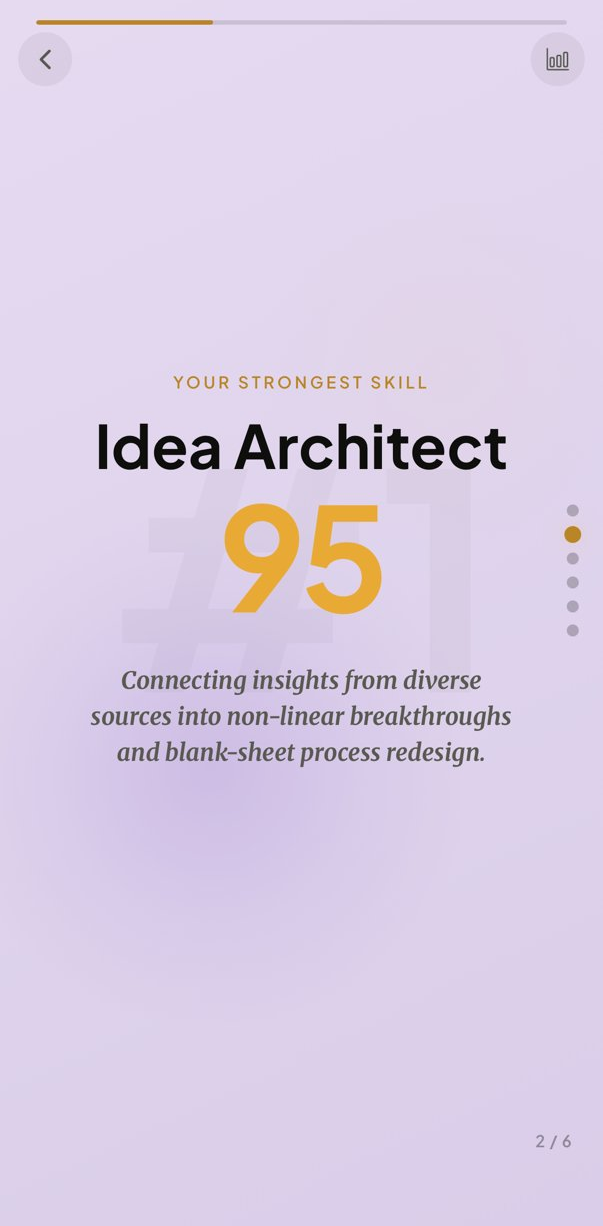
Your strongest skill
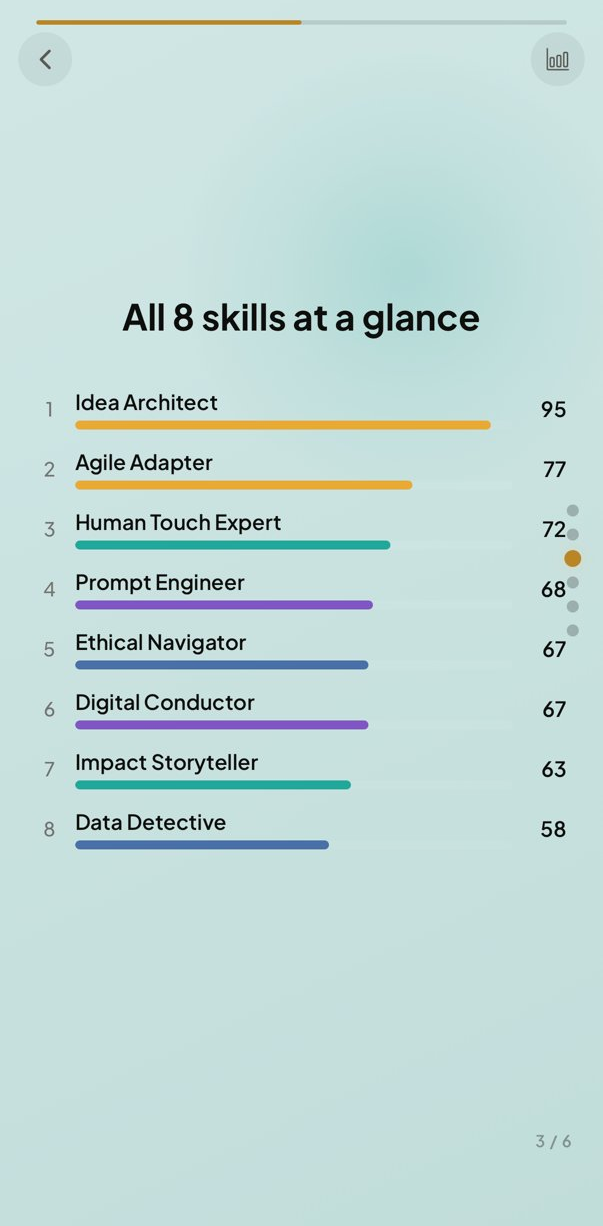
All 8 at a glance
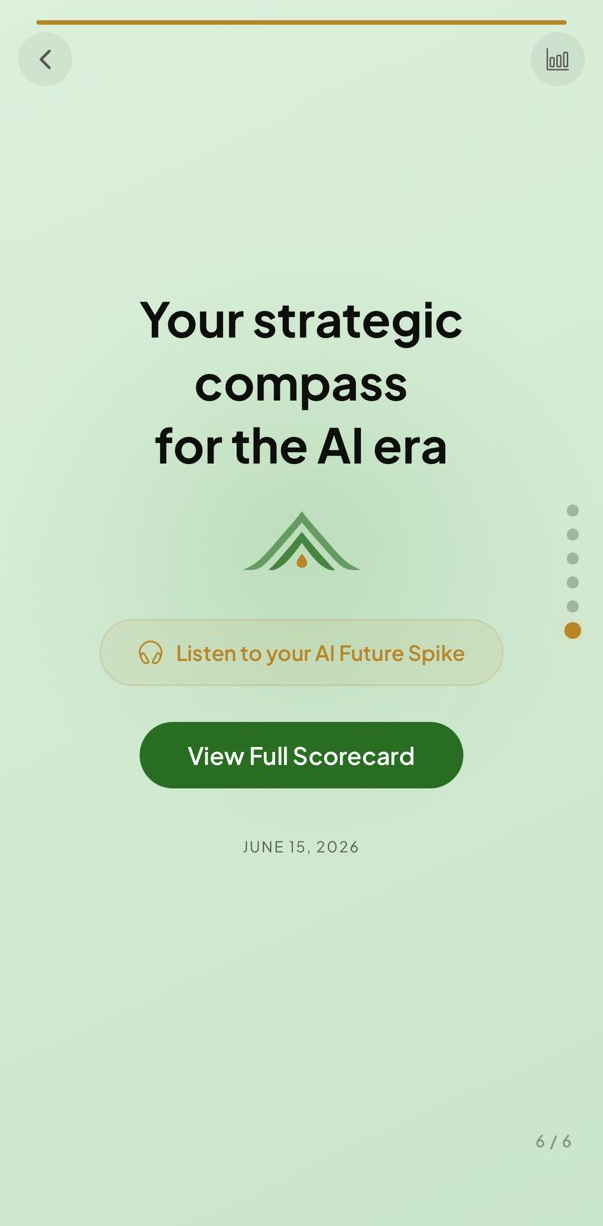
Your AI-era compass
How leaders use this data
A heatmap is only useful if it changes a decision.
Pilot selection
Identify your strongest Agile Adapters to run the first Copilot rollout instead of picking by seniority or who volunteers.
Pairing
Team a high-affinity Prompt Engineer with an Ethical Navigator to co-write your AI usage guidelines, pairing technical fluency with risk judgement.
Gap-closing
A team that skews heavily toward Idea Architect and light on Prompt Engineer is next quarter's training budget, decided for you.
€49 per person. Fifteen minutes.
No procurement drag.
€49
per person · one-time · no recurring seat licenses
- Private results webpage with affinity score and 1–8 ranking, for every person
- Research-backed role explanations and a personal audio briefing
- Organization dashboard of all 8 roles across teams (included for 1 year)
- Capabilities heatmap to match people to projects and roles
- Onboarding and a debrief to turn the data into action
Available from 100 people per organization.
Prices in EUR, excluding VAT where applicable. Reseller, white-label, and volume terms agreed per partnership.
Day 1
Your first 100 enroll
Your admin adds each person's email address and we send the invites. One 15-minute survey each, no prior data needed, no software to install.
Days 1–3
Instant, person by person
Each employee gets their own profile the moment they finish. No waiting for the full group to complete the survey.
Week 1
Dashboard live
The leadership dashboard fills as results come in: the collective picture of your team's AI affinity, ready for your next planning cycle.
Proven in practice
Grounded in decades of character research, mapped to the skills the AI transition demands.
The problem it addresses is documented by
Prof. Ethan Mollick (Wharton) · Prof. Tomas Chamorro-Premuzic (UCL)
Enterprise-ready by default
Fast to start doesn't mean loose on governance.
GDPR-compliant
Personal data is processed in line with GDPR. A Data Processing Agreement is available for corporate clients.
EU data hosting
All survey responses and results are hosted on servers in the European Union.
Built for your team
See how the AI Affinity Scan applies to your function, with the roles that tend to matter most for each.
HR & People Teams
A workforce-level map of the human skills that decide whether AI adoption succeeds. Built for the teams asked to lead the change.
Explore →
Management Consulting
A repeatable, research-backed instrument to diagnose any workforce's AI readiness, and to prove your own firm practices what it sells.
Explore →
Questions HR leaders and procurement ask
How do you measure AI readiness in non-technical teams, without coding tests?+
Assess character strengths such as adaptability, ethical judgment, and problem-solving rather than technical or coding ability. Employees complete a single 15-minute character survey; the AI Affinity Scan maps those strengths onto the eight Peak-8 roles and ranks them from strongest to weakest, giving each person an individual ranking and leaders an organization-wide dashboard showing where collective strength and gaps sit.
Which skills matter most for working effectively alongside AI?+
As AI takes over routine and technical work, the skills that matter most are judgment, ethical reasoning, adaptability, and clear communication, not coding ability. The Peak-8 Framework identifies eight such roles, grouped into four categories: Governance & Trust, Human Connection, Innovation & Change, and Operation & Logic.
What is the AI Affinity Scan?+
There's a place for everyone in the AI transition. It's just not the same place for everyone. The AI Affinity Scan is a character-based assessment that maps 8 human roles (the Peak-8 framework), showing where each person's affinity is naturally strongest. It's based on a 15-minute character survey, not coding tests.
How long does it take per employee?+
One 15-minute survey, once. Results, including a personal 1–8 role ranking, are generated instantly. No follow-up testing is required.
What does it cost, and is there a minimum order size?+
€49 per person, one-time, with no subscription, per-seat licensing, or platform fee beyond that flat rate. The AI Affinity Scan is available from 100 people per organization. The organization dashboard is included for 1 year. Volume and partner pricing are available for larger rollouts.
What do leaders see, and what do employees see?+
Each employee gets a private results webpage with their full profile. Leaders get an organization dashboard with the spread of all 8 roles across teams and a capabilities heatmap to match people to roles and projects, not a ranked leaderboard. There is no pass/fail: the scan is a development instrument, not an assessment gate.
How is our data handled?+
Personal data is processed in line with GDPR and all survey responses and results are hosted on servers in the European Union. A Data Processing Agreement is available for corporate clients.
Which languages is it available in?+
The survey and the personal results experience are currently available in English.
Can it connect to our existing systems?+
Yes. An API connection is available for organizations that want to sync results into an HRIS, BI tool, or internal dashboard, in addition to the standard webpage and reports.
How fast can we start?+
Today. Add your organization's first 100+ email addresses and we send the invites. No IT integration, no software to install. Each person gets their profile the moment they finish, and the leadership dashboard fills in as results come in, typically within a week.
Roll out in a week.
No procurement cycle, no software to install. Just the character data your team already has, mapped to the skills that matter.
The first profiles can be live today.
tex@peakpersonality.com · Based in The Hague, The Netherlands